The History of the Malay Kings in SIngapore
Sultan Hussein's History
 |
| Singapore as a port city (20th century) |
In 1819, Sir Stamford Raffles sailed to Singapore with the intention of establishing a free port for the British East India Company. Having lived for many years in the region, he understood that the spice trade in the Malay Archipelago as well as the strategic location of a port between China and India would be of paramount economical benefit for the British. Few know however that Singapore was NOT his first choice of a free port. He had looked to the South of Singapore first, to the Riau Islands but were unable to access them due to the Dutch hegemony of the region. The Dutch had an exclusive trading agreement with the Johore-Riau Sultanate and its territories stretched from Pahang in Peninsular Malaysia all the way to the Lingga Islands to the South. He had then looked at the Karimun Islands but were once again deterred because the Karimun Islands did not have a deep harbor required for large ships. His third choice had been Singapore which in 1819 was recently inhabited by the Temenggong. In a Malay Royal Court, the Temenggong is an equivalent to the Minister for Home Affairs. Raffles journey to Singapore was NOT coincidental nor was he ignorant of the political scene of the Johore Sultanate. The Johore-Riau Sultanate was in the middle of another succession crisis. Earlier in 1812, the Malay King, Sultan Mahmud III passed away but he did not leave a clear heir to the vast kingdom he had held. His royal consort (wife), Engku Puteri Raja Hamidah did have a son but he died at childbirth. Fortunately or unfortunately for him, Sultan Mahmud III had two other sons from non-royal wives: Tengku Hussein and Tengku Abdul Rahman. During his lifetime, he had favoured the eldest son, Tengku Hussein to be the successor of the Johor-Riau Sultanate.
However, there is a ploy. At the time of Sultan Mahmud III's death, Tengku Hussein was away in Pahang for a marriage. As with Malay Court culture (and this is important to note), the successor has to be by the deathbed of his father in order to be installed as the next king. Only Tengku Abdul Rahman, the younger brother had been present. The powerful Bugis king, YTM Tun Jaafar therefore used this reasoning to claim Tengku Abdul Rahman as the new Malay king and he was supported by the Dutch. And to understand why the Bugis kings had the leverage and power to claim as such, we have to go further back in history to 1699.
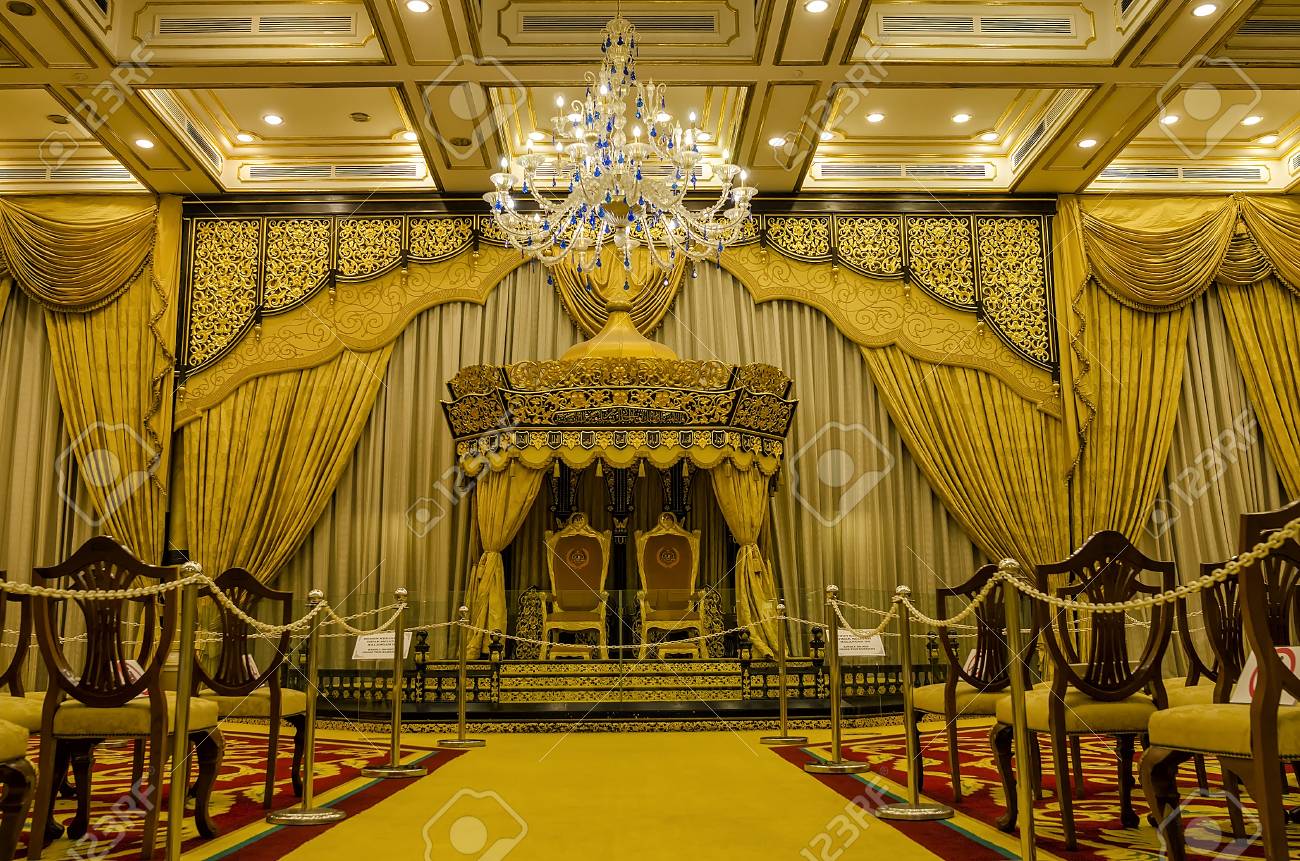 |
| Balairong (Royal Audience Hall) of the Istana Negara in Malaysia |
In 1699, Sultan Mahmud II died with no heirs to the Malay throne because he was actually murdered by one of his noblemen. If you believe in the Chinese's idea of the Mandate of Heaven, this is a prime example to use. Sultan Mahmud II was described as a cruel king by his people. During his reign, the Johor-Riau Sultanate was in frequent war with the Aceh Sultanate, another Malay kingdom. During one such war, Sultan Mahmud II had executed the pregnant wife of the Laksamana (Minister for War) just because she ate a slice of a jackfruit before the king ate it. When the Laksamana came back from the war campaign, he was so angry that he killed Sultan Mahmud II. The king's death marked the end of a long line of kings stretching from Parameswara, the founder of the Malaccan Empire and his death was also seen as the greatest tragedy to the Malay world since the Fall of Malacca to the Portugeuese in the early 15th century. The Johore-Riau Sultanate by then was in its golden age but the entire maritime kingdom was built on faith placed on its Malay kings and without a king, the entire Sultanate would fall apart. The Bendahara (equivalent to the Prime Minister), Tun Abdul Jalil IV rose to the occasion and with support of the other Malay noblemen was proclaimed the new Malay king despite not having of pure royal blood.
In 1715, the Bugis people, a strong, fierce and powerful community who migrated into the region from Sulawesi (present day Indonesia) sacked the Kedah Sultanate to the north. These Bugis settlers were living in the the area of Selangor, which was historically a part of the Johor-Riau Sultanate. Given the context, the newly proclaimed king, Sultan Abdul Jalil IV demanded half of the spoils from the sacking of Kedah which the Bugis people refused. Infuriated at the defiant Bugis people, he attacked them but despite having a numerically larger and a more superior military than the Bugis people, Sultan Abdul Jalil IV was unable to subjugate Selangor.
Adding to the complication, came a surprise contender to the throne in 1718 in the form of a prince from Minangkabau (another Malay kingdom from Sumatera, Indonesia). This prince who goes by the title of Raja Kecil (Little King) claimed to be the legitimate son of Sultan Mahmud II. The common people, upon hearing that there was a true surviving heir to the legendary Parameswara lineage, abandoned Sultan Abdul Jalil IV to support this new contender.
Due to the massive defection, particularly from the "Orang Lauts" or sea nomads that makes up the bulk of Sultan Abdul Jalil IV's army and the Minangkabau soldiers belonging to Raja Kecil, Sultan Abdul Jalil IV had no choice but to abdicate the throne and resumed his role as the Bendahara (Prime Minister) of the Johore-Riau Sultanate. Some historians argued that he and his family retired to Pahang that year while some argued that he fled there in fear for his life but whatever the reason was, he was executed on the orders of the Raja Kecil in 1721. Sultan Abdul Jalil IV's son, Raja Sulaiman and his family, was then taken captive to Riau, the capital of the Johor-Riau Sultanate by Raja Kecil.
The execution of their former Malay king and Bendahara created a wave of fear among the aristocratic Malay class in the Sultanate. Distrust gradually grew against who they saw as a "foreign" king with dubious royal claims. This turned out to be the opportune time for the Bugis people to step into the picture.
Due to the massive defection, particularly from the "Orang Lauts" or sea nomads that makes up the bulk of Sultan Abdul Jalil IV's army and the Minangkabau soldiers belonging to Raja Kecil, Sultan Abdul Jalil IV had no choice but to abdicate the throne and resumed his role as the Bendahara (Prime Minister) of the Johore-Riau Sultanate. Some historians argued that he and his family retired to Pahang that year while some argued that he fled there in fear for his life but whatever the reason was, he was executed on the orders of the Raja Kecil in 1721. Sultan Abdul Jalil IV's son, Raja Sulaiman and his family, was then taken captive to Riau, the capital of the Johor-Riau Sultanate by Raja Kecil.
The execution of their former Malay king and Bendahara created a wave of fear among the aristocratic Malay class in the Sultanate. Distrust gradually grew against who they saw as a "foreign" king with dubious royal claims. This turned out to be the opportune time for the Bugis people to step into the picture.
 |
| Johore-Riau Sultanate's Bendahara Dynasty's Family Tree |
The Malay-Bugis Alliance
In Bintan, Riau, came 5 Bugis royal princes. The Bugis people was by then a growing community in the Riau Archipelago following several mass migrations over the past few centuries. They were treated well as honoured guests by Raja Kecil. But they understood the political situation in the Johor-Riau Sultanate including the unease that the other Malay noblemen had of Raja Kecil. The five brothers secretly met the captive Raja Sulaiman, of whom his father, the former Malay king, was executed. After much discussion, it was formally agreed that if Raja Sulaiman could muster the support of the other Malay noblemen from the various Malay States in Peninsular Malaysia, the Bugis princes would call upon their own army to overthrow the Raja Kecil. Raja Sulaiman would then be named the next king of the Johor-Riau Sultanate. True enough, the Malay noblemen rose in support of Raja Sulaiman and with the combined forces of Pahang, Terengganu and the people of Selangor, he swept through the royal capital catching Raja Kecil by surprise causing him to flee for his life. Raja Kecil with his army of loyal sea nomads fled the royal capital in Riau towards Sumatera and would later on form the kingdom of Siak. From his dominion in Siak, Raja Kecil would wage constant petty wars against the Johor-Riau Sultanate but never tasted the throne from then on.
Thus, Raja Sulaiman was installed as the new Malay king of the glorified Johor-Riau Sultanate and given the hereditary title of "Yamtuan Besar" or "He who was made the Big Lord". In return for the Bugis's help, the hereditary title of "Yamtuan Muda" or "He who was made the Young Lord" was given to one of the five Bugis princes. This was the reason why there is both a Malay king and a Bugis king in the Johor-Riau Sultanate in the years that followed. One tradition that developed from this new friendship was the agreement that for every successive Malay or Bugis kings, the other king would have the honour of bestowing their rights to the throne, that is, a Bugis King will have to proclaim who the next Malay King is and conversely, the Malay King will have to proclaim who the next Bugis King is. This includes the handing down of the royal regalia, the symbol of power in the Johor-Riau Sultanate. This new strategic alliance between the Bugis and Malay people is well-recorded in the Tuhfat Al-Nafs, a book written by Raja Haji Ali, a Bugis prince. However, we can see why exactly such a tradition is not practical. The Bugis King can just proclaim a person whom they deemed as weak and the converse is also true.
Sultan Mahmud III is the direct descendant of Raja Sulaiman. During his reign as the Yamtuan Besar, he felt that the Bugis royal family were gaining too much influence and power. In a sense, Bugis were indeed running most of the show, that is, in terms of the administration of the Sultanate as well as the economics. Sensing that if he were to continue living in Bintan, Riau, he would only remain as a figurehead, he left Bintan with thousands of his followers to Daik, in Pulau Lingga to the South. There, he established the new Royal Capital for the Malay kings of the Johor-Riau Sultanate. His royal consort (wife), Engku Puteri Raja Hamidah which I had mentioned in one of the earlier paragraphs was given the island of Pulau Penyengat as a wedding dowry by Sultan Mahmud III. Pulau Penyengat would later become the royal capital for the Bugis kings, (the Yamtuan Mudas). This is because Engku Puteri Raja Hamidah is the daughter of Yamtuan Muda Raja Haji Fisabilillah who originally came from Selangor. This wedding dowry splits the Johore-Riau Sultanate into two spheres of influence: the Bugis who would now rule from their royal capital in Pulau Penyengat and the Malays who would rule from their royal capital in Pulau Lingga. Given all this background, we now come to the story of Tengku Hussein of Singapore, the son of Sultan Mahmud III.
 |
| Sir Stamford Raffles (1781 -1826) |
Sir Stamford Raffles and Tengku Hussein
When Tengku Hussein found out that the current Bugis Yamtuan Muda, Raja Jaafar had installed his younger brother, Tengku Abdul Rahman as the new king of the Johore-Riau Sultanate he sailed all the way from Pahang to Riau to set measures straight. He was after all, the heir apparent of the throne. Engku Puteri Raja Hamidah, had withheld the royal regalia, the symbol of power and refused to give it to Tengku Abdul Rahman because she also believed that Tengku Hussein should be the new king. Tengku Hussein sailed to Lingga, the royal capital of the Malay kings (the Yamtuan Besars) to confront his younger brother, Tengku Abdul Rahman to force him to abdicate from the throne. His younger brother told him that he did not want the throne in the first place but was nevertheless given it because of the flawed tradition of naming kings mentioned earlier. The new Yamtuan Besar (Malay King) had to be officially appointed by the Yamtuan Muda (Bugis king).
Tengku Abdul Rahman then left to find the Bugis king, Raja Jaafar to persuade him to appoint his older brother Tengku Hussein as the next Malay king but was once again denied. Tengku Hussein on the other hand was forced into exile by the powerful Bugis king in the Riau Islands with no possibility of claiming the throne. In this context, came Sir Stamford Raffles to Singapore where he met the Temenggong (Minister of Home Affairs) of the Johore-Riau Sultanate in 1819. By then, the Malay noble houses of Peninsular Malaysia were hostile to the threat of Bugis dominance in the Johor-Riau Sultanate. In fact, the Temenggong had actually fled to Singapore as he was unable to work with the Bugis king back in Riau. The Malay Bendahara (Prime Minister) who lived in Pahang at the time had little say over the succession crisis in Riau as he was too pre-occupied with running his own mini kingdom. Raffles had learnt everything he needed to know about the region. With the help of the Temenggong (Prime Minister) in Singapore, he invited in secret, the exiled Tengku Hussein to Singapore which was where he signed a document giving the British rights to establish a free port in Singapore. In return, the British would recognise Tengku Hussein as the rightful king of the Johor-Riau Sultanate. Thus, Tengku Hussein was given the official title of "Sultan Hussein" by the British.
 |
| Symbol of the Dutch East India Company |
This came as a shock to the rest of the Malay world but more importantly to another superpower at the time, the Dutch. The history of the Dutch with the Johor-Riau Sultanate goes a long way also and is a very complicated one. Recent documentation showed that as far back as the 15th century, the Dutch had a role in destabilizing the Portuguese control of the seas by collaborating with local Malay kingdoms. Due to the region's importance in the spice trade, the Dutch had established a trading post at Batavia in Java and installed a Dutch Resident to oversee trade in the Riau Islands. In fact, the Dutch once intended to form an alliance with the Malay kings to overthrow the Bugis in the region but was opposed by the Malays themselves. In addition, the title of Yamtuan Muda was also abolished for a short period of time by the Dutch but was later reinstated after Sultan Mahmud III moved from Riau to Pulau Lingga. Nevertheless, due to the superiority of the Dutch in terms of weaponry and wealth, the Johor-Riau Sultanate was at the mercy and political ploy of the Dutch. In fact, every appointment of the Yamtuan Besar and Muda had to be consented by the Dutch Resident. In return for not attacking the Johor-Riau Sultanate, the Dutch had signed an exclusive treaty of trade. No other colonising power was allowed to make trade with the Johor-Riau Sultanate.
Raffles and the Sultan Hussein
Raffles himself did not stay in Singapore for long. He sailed off to Bencoolen and left the care of the new port city to William Farquhar. Sultan Hussein was allocated a large piece of land at Kampung Glam along the Singapore River where all his followers including Malay and Arab merchants moved while the Temenggong (Minister for Home Affairs) and his followers moved to Teluk Belanga. Under the agreement with Raffles, he was to receive a stipend from the British. It was however, not long before he realised that the British were not there to actually help him in the throne succession but was there for their own interests just like the Dutch. Right before his eyes, he saw the last of the Malay bastion eroded as traders from all over the world flocked into Singapore. While some traders and merchants recognised the sovereignty of Sultan Hussein and offered tribute, the majority especially the Chinese and Indian merchants saw the British as the true rulers of Singapore. In a matter of a few years, the Malays became a minority on the island and thus, the influence of Sultan Hussein himself. Sultan Hussein was a figure of the past, living in ignorance as Singapore quickly developed.
The sad reality is that by calling in the British, Sultan Hussein had doomed the Johor-Riau Sultanate as he had effectively split the Sultanate into two halves. One half under the influence of the Dutch and ruled administratively by the Bugis in Riau and the other half under the influence of the British but with no significant political power based in Singapore. The other Malay noblemen in Peninsular Malaysia had been too busy running their own states to actually care about who the new Malay king was. They were probably glad that they would not have to deal with the Bugis kings again. To many of them, Sultan Hussein was responsible for bringing in yet another foreign invader into the Malay world. Sultan Hussein also did not wield the royal regalia, the symbol of Malay power which was held by his step-mother, Engku Puteri Raja Hamidah. The Istana Kampung Glam, the palace of Sultan Hussein in Singapore was soon to be the coffin for his many descendants to come as his world and influence rapidly diminished.
 |
| John Crawfurd, last British Resident of Singapore (1783 - 1868) |
John Crawfurd and the Anglo-Dutch Treaty 1824
Money problems and the end of Sultan Hussein
It was clear that Sultan Hussein thought he had absolute jurisdiction of the Johor-Riau Sultanate. It was only when John Crawfurd, the first British Resident in Singapore arrived that he realised that his title was nothing more than a bluff. Due to Raffles brazen act of declaring Sultan Hussein the king, the Dutch were furious and had escalated tensions in the region. As a result, the Anglo-Dutch Treaty was formally signed by the two colonial powers which literally split the Johor-Riau Sultanate into two. Peninsular Malaysia and Singapore would be under the British influence (new Johore Sultanate) while the Dutch would have control of the Riau Islands, Java and Lingga (new Riau-Lingga Sultanate). Sultan Hussein did not mind the split of course because it meant severing all ties with the powerful Bugis Yamtuan Muda who had been a bane to his claim to the throne. His younger brother Tengku Abdul Rahman however, was clearly very much disappointed. Not only would he now be fully under the control of the Bugis people but his fellow noblemen: the Bendahara (Prime Minister) in Pahang, the Temenggong (Minister for Home Affairs) in Singapore and his close families in Terengganu were in the other half of the partition. Perhaps in another post, I will talk more about Tengku Abdul Rahman.
Whatever joy Sultan Hussein may have felt was however short lived as John Crawfurd had other ideas. While Sultan Hussein did not interfere much with the rapid development of Singapore, he had expected the British to do the same. This is perhaps because the idea of land ownership to him was very different to that of John Crawfurd and the rest of the Malay world. Firstly, we have to understand that Johore and Singapore had been placed under the responsibility and jurisdiction of the Temenggong (Minister for Home Affairs). Having Sultan Hussein living in Singapore only further complicates this arrangement because technically he did not 'own' the land he was in despite him being the newly British-installed king. The first sign of trouble came when some of his harem living in his palace had sought the help of the British for apparent mistreatment. Hearing that, Sultan Hussein went out to get his harem back only to be told by John Crawfurd himself that his harem were under the protection of the British and that John Crawfurd would not tolerate the Sultan's behavior. This made Sultan Hussein very angry because he had assumed he was the law of the land. To him, his harem was his property and the British were just using his land for their business. Nevertheless, he was powerless in getting his harem back. The second sign of trouble came when John Crawfurd razed the walls of Sultan Hussein's palace to build a new road right in the middle of his own palace grounds. This was part of the British's ongoing efforts in developing Singapore into a fully functioning port city. Once again, he was powerless to stop John Crawfurd. Without the backing of the Malay people from the region, his sphere of influence extended only to as far as his own palace. To make matters worse, in less than a decade, the Malays themselves had become a minority in Singapore with traders from all over the world particularly China swamped into Singapore. These traders certainly did not care about Sultan Hussein because to them, the British owned Singapore and they were there because the British made Singapore into a free port. Sultan Hussein was not their king.
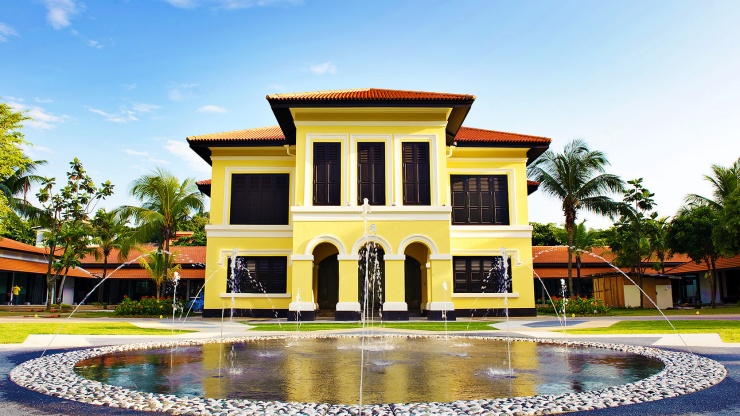 |
| Malay Heritage Centre (former Istana Kampung Glam) |
Money problems and the end of Sultan Hussein
The end of Sultan Hussein was a long and sad tragedy. In his ever shrinking dwelling, his family grew larger and larger. The stipend that he receives from the British had been enough for him alone but with his many children and grandchildren, money had become a huge issue. His offspring and their own families demanded more and more to suit the kind of royal lifestyle they had envisioned and as a result, his own wife had to call in a family friend, Abdul Kadir to help with managing the finance. This was so unpopular with the rest of the family that Abdul Kadir had to flee for his life to Malacca. Shortly after, Sultan Hussein himself followed to join Abdul Kadir in Malacca in 1834. Finally, after just 16 years after signing the pact with Raffles, Sultan Hussein passed away in Malacca, penniless and powerless. He was buried at the Tengkera Mosque in 1835 and his funeral was attended by several Malay noblemen. His legacy of course did not just end there. His son, Sultan Ali was proclaimed the next king and Sultan Ali was quite different from his own father in that he spent quite a number of his years championing for the diminishing Malay's rights. Although it was too late by then, the Istana Kampung Glam is what remains of the legacy that Sultan Hussein had left. Today, one who visits Singapore could visit his palace which had been renovated and transformed into the Malay Heritage Centre. To go there, you would have to take the MRT to Bugis Station (Ironically) and the Malay Heritage Centre is about 5-10 mins walk from the station just beside the Sultan Mosque. The Sultan Mosque of course was built at the time of Sultan Hussein (Hence, the name) and was originally the place of worship for his royal household.
If there are any discrepancies or if you would like to know more about this rarely told Singapore's past, you could drop me an email at wanaliff95@gmail.com
Comments
Post a Comment